Executive Summary
- Singapore’s rapid adoption of digital payments has made efficiency, speed, and convenience the default expectation of everyday transactions. This project examines who these systems assume as users, who gets left out, and at what cost.
- Between January and February 2025, I conducted 29 semi-structured interviews with Singapore residents aged 26 to 80.
- Findings:
- Digital payments produce a mobile, always-in user who reorganizes their daily routines around transactional convenience. These services set the tempo for urban engagement in the city, creating a standard rhythm of engagement in the city that values efficiency, speed and convenience.
- At the same time, efficiency is not always valued by users. Exchanges like wedding gifts or red packets during Lunar New Year convey social meaning that frictionless systems that prioritize speed and convenience can erase.
- When digital payment systems fail through scams or fraud, the cost falls unevenly among the population. For elderly users, a single incident can undo years of adoption and can lead to withdrawal from digital and urban engagement.
- Recommendations: (1) Payment providers should design for social meaning, not just complete transactions: evaluating products on more than speed, co-designing gifting features with users and preserving deliberate friction where gifting is the point; and (2) financial institutions and agencies that handle scam cases should invest in prevention and recovery: examples of this include compassionate response protocols for frontline staff, follow-up check-ins with those affected, and community programs that rebuild digital confidence so that scams do not lead to public distrust of digital payment services.
Overview and Research Questions
Digital payment technology has advanced steady in recent years and we are now accustomed to non-cash modes of payment: from NFC-enabled transactions to scanning QR codes to the increasing normalization of cryptocurrencies. These new infrastructures of payments have thus changed city residents’ expectations of everyday transactions: whether at the grocery store or in restaurants, people are increasingly reaching for their phones or smartwatches rather than cash. The expectation, in other words, is for transactions to be efficient, convenient, and fast.
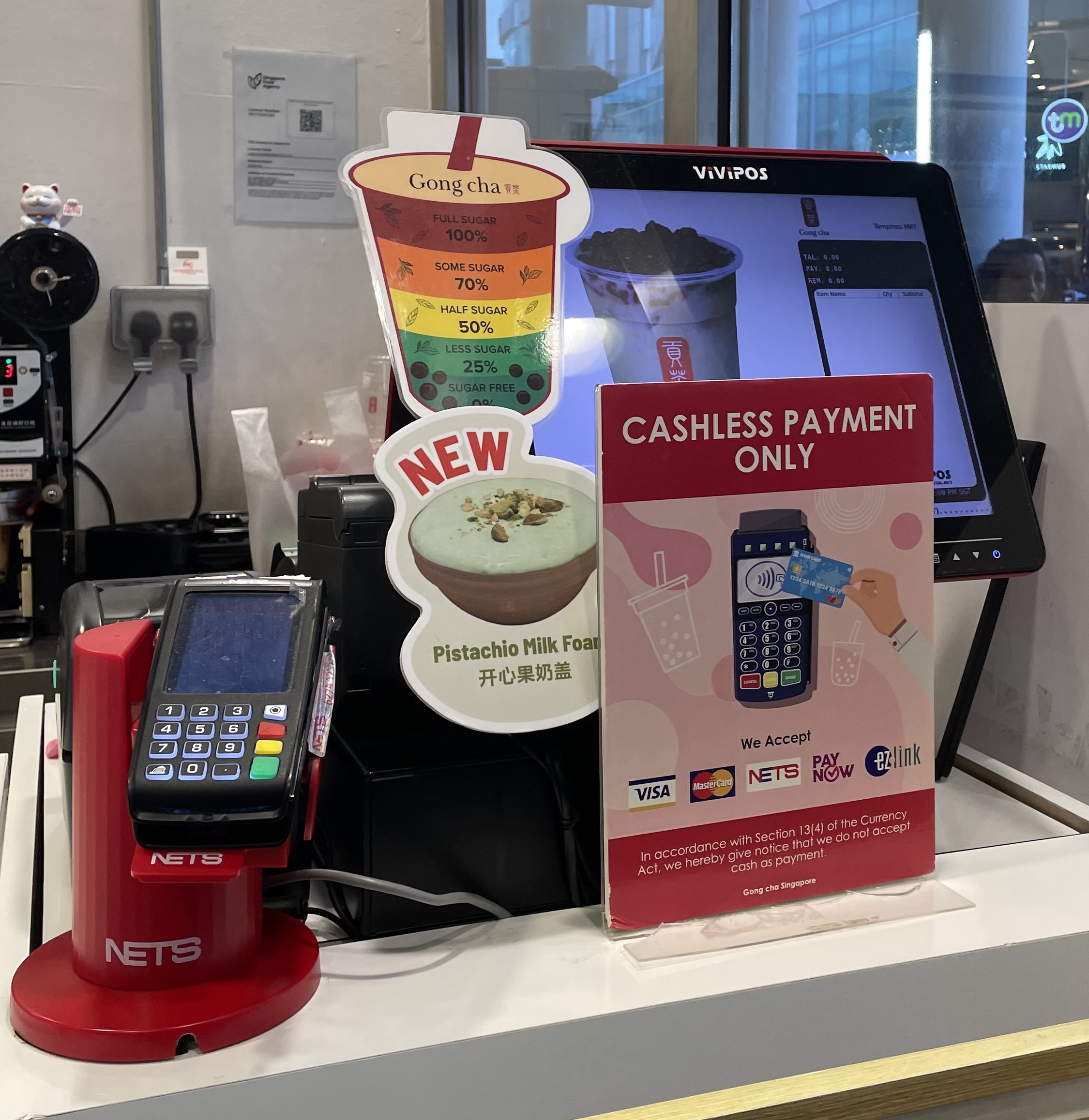 While not the norm, it is increasingly common to find stores like the ones above that only accept cashless payments. Photo by author, Singapore, January 2025.
Within this changing landscape of payments, how are urban residents modeled? Which groups are excluded from these infrastructures, and with what consequences? This project focuses on digital payment adoption in Singapore through a lens of inclusion and exclusion. In it, I focus on how residents are using the city’s expanding payments infrastructure and the costs–socially, culturally, and financially–of doing so.
Specifically, this project asks:
- What kinds of users and behaviors do digital payment systems assume, and what happens to residents whose lives do not fit within that mold?
- Where does the logic of efficiency and convenience come into tension with how residents actually experience and make meaning from everyday transactions?
- When these systems fail, who bears the cost, and how do users respond?
Methodology and Timeline
For this project, I recruited participants using a Singapore-based Telegram channel that regularly posts calls for research participants. Between January and February 2025, I held a total of 29 semi-structured in-depth interviews that lasted between 30 - 90 minutes. My interviewees were aged between 26 and 80 years old.
During the interviews, participants discussed their use of different mobile payment apps, distinctions between cash and cashless payments, and the challenges they faced navigating the country’s changing payments landscape.
The interviews were then manually transcribed1 and the resulting text was uploaded to Atlas.ti and coded inductively.
Findings
1. Digital payments produce a mobile, transactional, and always-on user.
Across the interviews, it was clear that residents were not just accustomed to using digital payments, but they were also reshaping their daily routines around them. City residents described using digital payments to coordinate their daily commutes and eating habits, often with the explicit goal of saving time.
Collectively, digital payments thus generate new rhythms of urban participation. In other words, digital payments enable residents to synchronize themselves with the city, producing the mobile, transactional, and always-on city inhabitant.
“McDonald’s always takes time to prepare your food, especially at the outlet at my neighborhood, so I order when I’m on the train, and when I reach the branch, I get it. So it’s more convenient, I don’t have to wait so long.”
The McDonald’s example above captures this well. The user ordering on the train is using the app to organize her day, it is convenient and saves her time in the process. At the same time, she is engaging with a system designed to produce this very behavior: frictionless consumption tightly choreographed between service and payment providers across the city.
This mobile, always-on user was a figure I often encountered in my interviews. Participants comfortable with digital payments were often timing deliveries–whether food or otherwise–to fit their busy schedules. Digital payments, as such, are no longer just about transactions, but also about city participation. The ever-mobile resident uses digital payment to participate in their urban landscape on their own terms, at their own time.
Implication: Such seamless digital experiences are rarely neutral. They are built around an assumed user: mobile, always-on users who are willing and able to use transactional convenience enabled by digital payments to reorganize their daily routines. At the same time, what this study surfaces is how that very seamlessness can also be exclusionary: the same system that frees up some residents can also set the tempo for everyone else.
2. Users are not always optimizing for efficiency, forgetting that can strip meaning from social exchanges.
Most users said digital payments were simply better. For most interactions, they were right. Digital payments are convenient and low-effort. They reduce the physical weight of carrying cash and coins and the mental stress of on-the-spot calculations. For many of my interviewees, digital payments were an efficient way of operating in the city.
Nonetheless, such efficiencies were not always prioritized or welcome. We may live in cities, but our lives, even when dealing with money, are not always about optimizing for efficiency. In my interviews, it was also the case that assumptions about digital payments as faster and more efficient broke down the moment that the exchange of money was seen as more than just the simple movement of value from one hand to another.
In Singapore, the physical exchange of money is, in certain contexts, inseparable from its social meaning. The red packet–a gift of cash given during Lunar New Year or at weddings–is one such example where the act of giving carries the weight that the transfer of value alone does not.
During interviews, residents often commented on the difference between an electronic red packet (locally known as “e-angpows”, a service provided by many local banks) and a physical one; or the difference between a simple bank transfer and a physical envelop filled with cash (a common wedding gift):
There’s no feeling in [using e-angpows], this whole thing just falls back to tradition. It’s not about convenience; it’s about the meaning behind [the practice]. So long as the meaning is there, then we should stick to that. We cannot simply convert everything to electronics, there is no value in that. (emphasis added)
Similarly, one resident told me that she enjoyed the feeling of a “thick” envelop of money given to couples at weddings:
I still like that feeling. If everything is digital, then no warmth in the exchange.
These expressions are not ones of technophobia or nostalgia; rather they are observations about what gets lost when the logic of efficiency is prioritized.
Implications: Digital payments built around efficiency and convenience rest on an implicit assumption: that what users want from an interaction is to complete it quickly. This study shows that not every transaction is a transfer of value. For some exchanges, such as gifting money at weddings or handing a loved one a red packet during Lunar New Year, the act of gifting carries meaning that does not translate easily into the move to frictionless transactions. This is the difference between optimizing for completion and accounting for what an exchange actually means to the people completing it.
3. Digital inclusion needs to account for who bears the cost of breakdown.
By many measures, Singapore’s shift towards cashless payments has been a success. Across interviews, contactless payments had become unremarkable for most residents: clearly woven into the fabric of daily life without much friction or thought. The “last mile” problem that once loomed large in digital payment adoption has, for many, disappeared.
On the other hand, this story of seamless integration sits alongside another one. Rising scam cases in Singapore have made digital transactions feel precarious for one particular group: the elderly. For seniors already navigating the edges of digital participation, the threat of scams looms. For some, it can be enough to pull them out of many forms of digital participation; for others, it can leave them suspended in a state of anxiety and distrust that makes ordinary urban participation feel risky.
When digital payment systems fail, be it through scams, fraud, or breach of trust, the fallout is not shared equally. For residents who were already navigating digital life with less confidence, the aftermath can be paralyzing: a withdrawal from transactions, a distrust of systems that others use without a second thought, and an exclusion from broader urban participation. Consider, for instance, the experience shared by a 57-year-old resident:
What happened was: my mother thought her friend called her asking for money. The caller gave her a bank account number. She transferred it across and then couldn’t contact her friend anymore. Finally, through social media, she contacted her friend and asked, “Why didn’t you answer your phone?” He said, “I’ve changed my phone number, and I never asked you for money.” Then she reported the incident to the bank and the police, and the police said, “You knew, you were given the bank account number, and you knowingly transferred. Yes, it’s to the wrong person, but you knowingly transferred, so say bye bye to your money.” And it was four figures, so it’s not a small amount. And then for the bank to just tell her to just “say bye bye to your money”. It’s just very, very painful. So… it just happened too fast. Everything happens so fast.
Below, she continues, drawing a clear distinction between financial and emotional consequences and her concerns about what that meant for her elderly mother’s ability to fully participate in the city.
Afterwards, you know, I transferred her the same amount and said, “Ah, never mind, take it that I paid your friend.” But she still feels the pain of losing that money, even though she didn’t lose the actual money because I have already given it back to her. But she feels the pain, and the worst thing is she feels the stupidity of doing that, and she feels even more scared of this world now. And her confidence level has dropped. For the longest time she was saying, “I’ll just use cash, I’ll just use cash.” I told her, no no no no, you cannot go backwards, you must go with the [flow]… And she’s still very healthy! I think she still has 10 years, if not 20 years more to go. And at this rate, if she doesn’t learn now, she’s going to be left, left behind by the whole world. But every time you hit her with something like that, she, she… you know, it hits her confidence. It hits her… her pride. Everything… I feel sad, I’m about to tear up because I lived through it with her, and it’s been so hard to pull her out.
Implication: Digital inclusion is often measured at the point of adoption and level of competence: did the user gain access, did they start using the system? How well are they using the system? But this study points to a different and arguably neglected metric: what happens when a system fails, and who bears the cost of that failure? In the case of digital payments, for elderly users already navigating digital life with less confidence, a single scam incident can be enough to undo years of adoption. The quote above illustrates this at a logistical level and at an emotional one as well: the loss of confidence, the shame, and the withdrawal from participation. Digital inclusion, as such, should not end at access and competence, but also needs to account for what happens to people when the systems that they come to rely on fail them.
Recommendations
1. Design for social meaning, not just complete transactions.
Digital payment services typically prioritize speed, convenience, and efficiency. Yet for exchanges like red packets during Lunar New Year or wedding gifts, the act of giving is the point. Rather than reskinning a standard transfer, payment providers could co-design gifting features with users to address what matters in these modes of gifting (shared presence and a physical handover). This could also mean designing relational elements into these systems, such as incorporating additions like voice notes or video messages that preserve social connection between gifter and recipient.
2. Invest in recovery as well as prevention.
Singapore’s response to scams has been largely preventive, from ScamShild to police hotlines to public awareness campaigns. Yet the prevalence of scams in the city suggests that prevention is not sufficient: in 2025, there were over 37,000 reported cases and over SGD 900 million lost (about $700 million).2 This study reveals a gap in what happens after a scam occurs. For elderly residents especially, the harm of a scam is not just financial, but also comes with a loss of confidence, shame and even a withdrawal from digital payments altogether. These costs are currently absorbed privately by individuals and their families.
Instead, financial institutions and agencies that handle scam cases could treat recovery as part of their responsibility. This could mean creating compassionate response protocols for frontline staff, such as training bank and police staff members to give victims a clear point of contact and next steps in a way that respects their emotional experience. Institutions could also conduct follow-up check-ins with victims and their families so that families are not left to carry the emotional and practical fallout alone. Finally, digital inclusion metrics could track whether users continue using digital financial services and how their confidence changes. Such measures would help show how digital inclusion and exclusion shift in the wake of harmful incidents like scams, and inform policy and community outreach programs that help victims rebuild their confidence.
Reflections
I really enjoyed reflecting on the relationship between what Ned Rossiter calls “logistical media”—the infrastructure and labor that sustains the movement of people and commodities across space—and digital payments. It is not at all a far leap to read a microcosm of logistical media embedded in the city by looking at the relationship between e-payments and urban mobility/participation.3 Put simply, can we think of the adoption of NFC-enabled payment systems and QR-code payment infrastructures as part of a system that structures our participation in the city? How do these technologies shape our experience of the urban and our place within it? How does that change our experience with time? Thinking on these terms helped me recognize the different registers of inclusion and exclusion arising from digital payment use.
That said, if I were to conduct this research again, I would have focused on just one group of residents: the elderly in Singapore. Over the course of the project, I came to see that their experience best captures the shifting experience that I was most interested in: the move from cash payments to the current ubiquity of cashless payments. This group also experiences, perhaps most explicitly, the structural (and temporal) pressures of digital payments, and in that sense more research could be done with this group to make headway into improving digital policies and inclusive design.