Executive Summary
- The Smart Nation Builder was a mobile exhibition run by Singapore’s Smart Nation Office that travelled to residential neighborhoods to gather feedback on digital government services.
- Through participant observation conducted between September 2022 and June 2023, I examined how the exhibition structured civic participation, who it imagined as its participants, and how its design shaped the quality of feedback it solicits.
- I found that the Builder’s mobility brought diverse audiences. Yet its design – encouraging login via a digital ID, touchscreens, and English-only content – assumed a digitally literate, English-speaking user. For these visitors, civic participation was seamless.
- However, for elderly and non-English-speaking residents, their engagement with the Builder was marked by friction and dependence on staff members, who translated and mediated their feedback. This raises practical and methodological questions about how design influences civic participation.
- I recommend (1) designing for the project’s actual range of users, including a more visible manual registration and localized content; (2) creating a structured channel for frontline staff feedback to reach designers; and (3) matching the research format to the goal, complementing reach with in-person methods like focus groups and interviews.
Overview and Research Questions
The Smart Nation Office in Singapore launched the Smart Nation Builder, a mobile exhibition designed to gather resident feedback on government digital services. On its face, the initiative appeared to promote inclusive civic participation: on deployment days, the Builder would be driven out to different spots around the island, thus bringing its feedback for infrastructure to city residents.
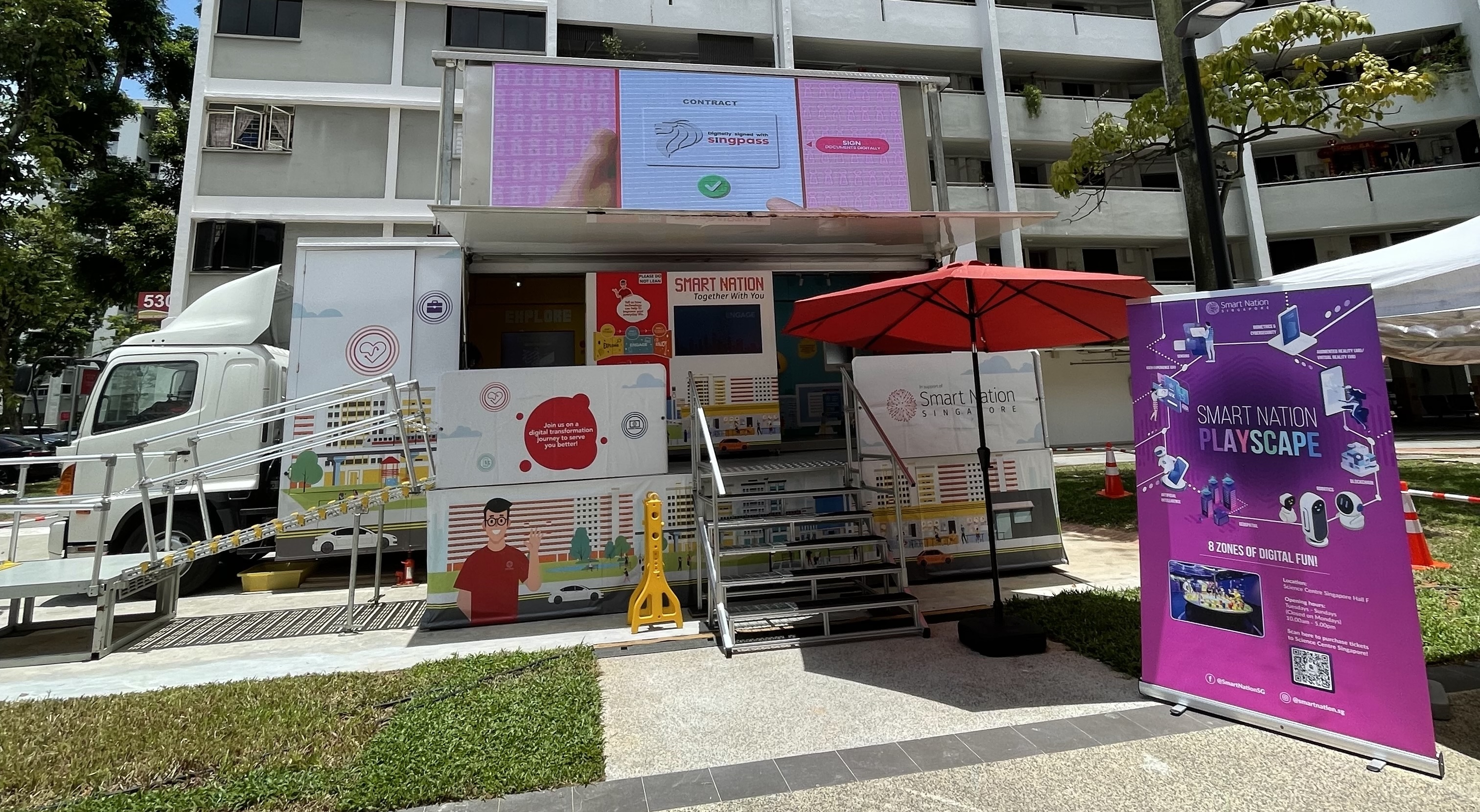 The Smart Nation Builder, an interactive mobile exhibition meant to share information about Singapore’s smart city projects and to gather citizen feedback on local digital initiatives. Photo by me, Singapore, 2023.
A key theme within the smart city literature has been citizen engagement and citizen participation.1 What role does the citizen play in the making of the smart city? How do their voices and perspectives guide ongoing projects – if at all? Given these questions, I was interested in the Builder as a site of citizen engagement: who was actually giving feedback? Did the Builder’s design foster meaningful encounters with residents and thus transform their feedback into decisions on civic tech?
The project asked the following:
- How is participation structured by the Smart Nation Builder? What forms of participation are encouraged? Conversely, what is left out?
- Who are the imagined participants of the Smart Nation Builder—and who is left out?
- How do design assumptions shape the quality and texture of civic feedback?
Methodology and Timeline
For this project, I conducted participant observation between September 2022 and June 2023. To understand how citizen engagement was designed at the Builder, I embedded myself in the city under two roles (in addition to my role as a researcher): as a Smart Nation Ambassador, an official volunteer with the Smart Nation Office; and as a part-time employee–at the Builder. These two roles gave me different positionalities from which to explore the questions above.
As a Smart Nation Ambassador, I volunteered for three-hour stints at the Builder and reported to the Smart Nation Office employee stationed on-site. My responsibilities centered on guiding visitors through the space: helping them get situated at the Builder and accompanying them across its eight stations. As a part-time employee, I worked with the agency contracted to run the Builder. In this capacity, I took on a broader set of tasks: beyond guiding visitors, I also assisted with setting up and closing the Builder on days it was deployed.
Findings
1. Participant engagement was designed to be seamless.
The Builder brought civic engagement into the residential areas, what local residents would familiarly call the “heartlands” of Singapore2, which helped extend its reach. This mobility no doubt increased its foot traffic, and more importantly, ensured that Builder reached a diverse audience.
At the same time, there were key elements on the Builder that assumed specific competencies of its user: for example, its registration kiosk nudged visitors to login via Singpass, Singapore’s national digital ID, rather than opting for manual entry. By scanning a QR code generated by the kiosk, residents would be able to authenticate their identification via their smartphones and allow the sharing of their personal information with the Smart Nation (primarily their name and date of birth). At the same time, the Builder’s interactive screens assumed that visitors would be comfortable navigating on large touchscreens in English. In other words, the Builder was designed for a primarily digitally-literate, English-speaking user.
For visitors who met these conditions, their experience was seamless: registration took seconds with their Singpass authentication, and many were able to move through the Builder independently, clicking through its infographics and providing feedback via its screens when prompted.
2. These design choices constrained which groups were able to participate seamlessly on the Builder.
For visitors who fell outside of the Builder’s assumed user profile, their experience on the Builder was marked by friction. Residents unfamiliar with Singpass–whether due to a forgotten 6-digit pin or difficulties with scanning the kiosk’s registration QR code–created barriers even at registration.
These frictions would carry over onto the Builder itself. Many elderly residents, notably already struggling with digitalization projects3, struggled to engage with the Builder’s content and leaving feedback on ongoing digital government services. Many residents were not English-speaking, but instead communicated in Tamil, Malay, or one of several Chinese dialects. These frictions were smoothed over by Builder guides (the Smart Nation Ambassadors and part-time workers), who often had to guide elderly visitors individually through each station, translating content and visitors’ responses in order to enter their feedback into the Builder’s system.
Ultimately, these design choices created two diverging experiences of participation: for digitally-literate English speakers, the Builder collected some of the best themes of a city’s “smartification”: the ability to register seamlessly with one’s digital ID, the ease of navigation on its touchscreens, and the ability to leave feedback to city developers on existing projects and potentially have a say in shaping the future of the city. Yet, for members of the public who fell outside these categories, their experience was one of high friction and dependence. It was, in other words, an experience marked by waiting: waiting for aid, waiting for content to be translated, waiting for their own feedback, in turn, to be translated. Furthermore, some elderly respondents, anticipating the need for translation, simply turned away from engaging with the Builder once they learned its content was only available in English.
3. Does feedback mediated through intermediaries still count as civic engagement?
The frictions described above pointed to a relatively straightforward design fix: while printed text could remain in English, content displayed on interactive touchscreens could be translated into Singapore’s other official languages (Malay, Tamil, and Mandarin).
More interestingly, they raised an important question of methodological rigor: if Builder staff members were actively mediating visitors’ engagements, what does that mean for the integrity of its collected feedback? Put differently: does feedback collected this way still count as civic engagement, filtered through the thought processes and words of an intermediary?
Yes and no. In one sense, yes: summarizing or synthesizing visitor responses (which was much of that the Builder staff were doing) still constitutes a form of resident feedback. One could go further and characterize staff as provocateurs: not merely reading questions aloud, but also prompting and even co-constructing responses with visitors. In doing so, their involvement may have produced richer commentary than what visitors would have offered independently.
That said, this describes an ideal scenario. In my observations, it was often the case that peak periods of high footfall compromised feedback quality. Staff already managing crowd flow were incentivized to move visitors quickly through each station, resulting in abbreviated comments, in some cases, bypassing feedback sections entirely.
Beyond the question of whether such feedback counts, then, a more important finding is that diversity in the design of civic participation matters greatly. In this case, language matters. An under-explored dimension of the Builder’s design assumptions concerns language not just as a practical, operational barrier, but also as a condition for meaningful self-expression. When residents are required to provide feedback in a language that they are not comfortable with, what is lost is not just accuracy but also nuance: the exact kind of specificity that makes qualitative feedback (and qualitative research) useful. A resident who is fluent in Tamil or Malay but only functional in English may be able to convey that a digital service has not been working well for them, but they are less likely to convey why, or to do so in a way that carries the texture of their lived experience. That the Builder was designed with English as its sole feedback language is thus not a neutral technical decision; instead, it encoded assumptions about who was expected to participate, and on which terms. Designing for mother-tongue input would not only have reduced friction, but would have also signaled that all residents’ voices were welcome in the registers that they were most comfortable in.
One immediate recommendation shared by me (and fellow guides) was for the Builder’s content to be translated into at least three additional languages. This would then include the other official languages of the city-state (Malay, Tamil, and Mandarin). Presenting content in residents’ mother tongues would have signalled a more welcoming engagement environment, and would have reduced friction for both visitors and the staff tasked with mediating their experience.
Recommendations
1. Design for the actual range of users.
The Builder’s registration and interface design assumed a digitally literate, English-speaking visitor. A more inclusive design would make manual registration as visible and frictionless as digital ID authentication, and would localize content for the Builder’s audience from the outset.
2. Build a structured channel for frontline staff feedback.
The Builder’s staff members absorbed the cost of design gaps in real time, translating and guiding visitors who couldn’t navigate the space by themselves. Yet there was no formal channel bringing their observations and experiences to the Builder’s developers. An iterative feedback loop between frontline staff and the Builder’s design team, which could take the form of an online survey or an in-person debrief, could surface friction points.
3. Match the research format to the goal.
The Builder’s format worked well for broad reach and lightweight feedback collection. At the same time, for populations less comfortable with digital interfaces, or for feedback requiring more depth and nuance, in-person formats like focus groups or interviews would likely yield richer and more actionable input.
Reflections
Designing for broad participation often defaults to designing for a “typical” user. In this instance, the Builder illustrates some of the costs of that default. As with my reflections on digital payments, elderly users are not edge cases: their experiences reveal important truths about how digital change is received more broadly, and should inform design from the outset rather than something addressed as an afterthought.
In doing this research, I was struck by how open people were to conversation. Where the Builder worked best, it seemed to have happened almost incidentally, as a provocation for deeper dialogue. Prompts about specific projects like an ongoing digital health project, the National Steps Challenge, sparked organic conversations in which members of the public shared their experiences using wearables and even offered suggestions for the project’s improvement. This relational, conversational quality of engagement may be worth deliberately designing for in future initiatives, whether for civic engagement projects or otherwise.
For some analyses on citizen participation, see the work of Mattern 2020 and Cardullo and Kitchin 2019 ↩︎
“Heartlands” has been typically used to reference residential areas of Singapore ↩︎
See Ng et al. 2021 and Chib et al. 2022 for recent work on digital exclusion and the experiences of the elderly in Singapore. ↩︎